
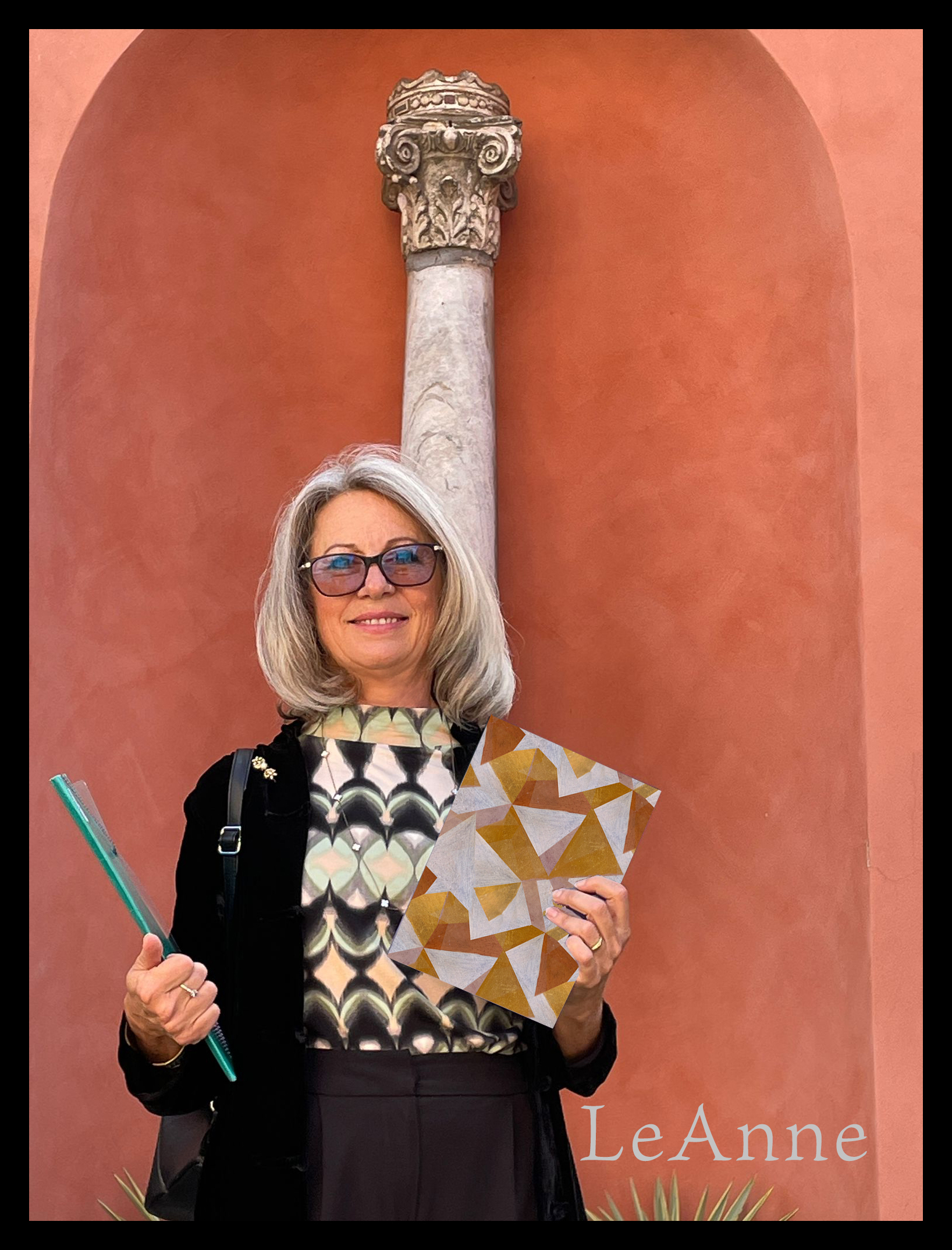
LeAnne Nowell
ARTIST BIO
Independent surface pattern designer
My creative story begins in Greytown, a small rural town in South Africa, where I grew up surrounded by expansive gardens, rolling farmlands, and the ever-changing colors of nature. Those early years were filled with wildflowers, homegrown blooms, vegetable garden activities. All set in the vibrant beauty of the African countryside—experiences that still shape my work today.
I’ve always been drawn to the intimate details of nature, from the delicate structure of a single petal to the sweeping rhythm of climbing vines.
After studying Textile Design in Durban, raising a family in Greytown and working as a freelance artist, I found my way to Rome, Italy, where I now live and work as a surface pattern designer and artist.
Living in Rome has added a rich new layer to my art. The city’s history, art, and romantic gardens have given me a renewed appreciation for bold design, classical beauty, and the way color can evoke emotion. My studio here blends my South African roots with my European surroundings.
Today, I specialize in hand-painted watercolor florals and vibrant pattern work, bringing a love of nature and energy to everything I create. Whether it’s licensing work for international clients, textile collections, or personal projects, my art is always rooted in celebrating the beauty of flowers and the landscapes that inspire them.
I offer custom artwork for license and sell my patterns and prints online through print-on-demand companies like Spoonflower, Redbubble, and Etsy. If you would like to commission a personalized artwork, pattern or collection, please send me a message. You can do it via my contact page.

about my design process
Most of my patterns begin with a watercolor sketch. I then photograph it and use photoshop to isolate the image from the background. Once all the individual images are saved I can move them around my page to create a layered pattern.


education
Back in the 1980’s, at our university faculty, there was no such thing as computer software to do the job. We were taught how to craft patterns by hand. We used a lightbox to trace our drawings and create a repeating design.
Silk screen technique
Each colour in the design was carefully traced onto a separate sheet of paper. It was then transferred onto a silk-screen. You would need a separate screen for each colour. The screen was coated with a uv light sensitive emulsion and exposed to uv radiation. After exposure you would be left with a stencil on the silk-screen. It’s was quite a process!
Once the screens were ready we would prepare the roll of fabric to be printed. By smoothing it onto the surface of a long table, using a special glue to hold it in place. Then we would carefully measure out and mark the repeat size. This ensured an accurate print location every time you moved the screen to the next panel. Then pull the ink across the screen using a squeegee (looks like a large rubber window wiper). The process was repeated for each colour. It was important to keep your palette to a minimum! Now we have printers which can make 30 000 colours all at the same time.
